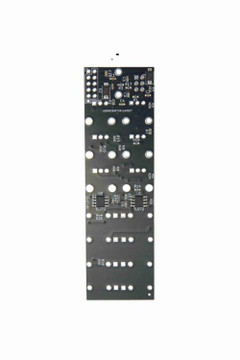
Spectrum is a 16hp switched capacitor filter with resonance control but unlike other switched capacitor filters (like Clot) it is not driven with an onboard oscillator. It instead takes an input signal and uses it as a clock to switch the capacitors within the filter (this is only true for input 1 on the left though, input two needs a separate clock if you want to clock it by itself i.e using the unit as 2 mono filters otherwise it will use channel 1’s clock). There are also separate/optional clock inputs if you want to use a separate audio or clock signal to clock it.
SPEKTRUM has (per channel) : Frequency control, resonance control, 3 different inputs, one for an optional external clock (mentioned above), an input for clocking the unit as well as audio in (also above). A second attenuated input for mixing in another signal. With nothing inserted here the gate outs (available in the middle) are present for pinging the filter. There is also an output and 3 switches for dividing the incoming clock in different ways. Both channels have the same set up but different cap values and divisions make it (in some settings) to alternative between rhythms and patterns between left and right. Input for audio/clock is normal from channel 1 to channel 2. In the middle there is an AND logic output for both channels clocks. A mix output if you want to use both channels but in mono.
So in short, inserting a signal into the input creates sequences, rhythmic patterns and basslines depending on settings on the module but also depending on the input (as an experiment use the wave multiple out signal from Bristol Bloodhound and multiply the waveform while inserted into Spektrum. It will behave differently while scanning the incoming signal). Sweeping the incoming signal, filtering it or run it through a reverb before spectrum will most likely create interesting and varying results). Got it? There is a YouTube video explaining it even better!